Arthur Mee |
Home..............Paintings...........Sculpture.............Hybrid Photography.............Experimental Films...........Straight Film Pinewood.........Alien.........Other Films.......NFTS.......Scenic Work.........Arkadon........Biography Star Wars.........Falmouth School of Art.........Annunciations |
|
|
| Arthur Mee at his desk in Temple Chambers, Londom, while editing the first edition of the Children's Encyclopedia. The current number stands in front of him, the first seven bound volumeson top of the desk. The portraits on the wallare those of his daughter Marjorie and Lord Northcliffe. |
Arthur Mee (1875–1943) was a British journalist, editor and educational writer best known as the creator and guiding force behind The Children’s Encyclopaedia. Born in Stapleford, Nottinghamshire, into a large nonconformist family, Mee was largely self-educated and deeply committed to learning as a moral and social good. After establishing himself in London journalism, he worked with the publisher Alfred Harmsworth, through whom he developed The Children’s Encyclopaedia (first published 1908–10). Conceived as a revolutionary alternative to traditional reference books, the encyclopaedia presented knowledge thematically rather than alphabetically, combining science, history, literature and moral instruction in a form designed to inspire curiosity and wonder. It became an international publishing phenomenon, selling millions of copies across the British Empire and the United States (where it appeared as The Book of Knowledge). Through the encyclopaedia and his other publications, Mee sought to educate children while shaping character, promoting ideals of progress, patriotism and moral responsibility. His work left a lasting mark on twentieth-century childhood education and home learning. |
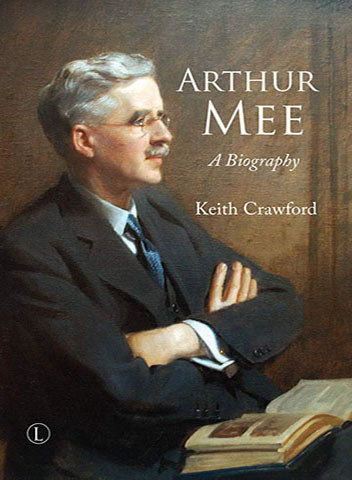
| Keith Crawford wrote the book - Arthur Mee - A Biography in 2016, here is a condensed version of the preface: | |
 |
|
This book emerged from my long-standing interest in curriculum materials and their ideological construction, particularly how textbooks and other educational media shape—and are shaped by—political, cultural and social values. In 2013, I extended this work beyond school textbooks to early-twentieth-century children’s magazines, which I came to see as powerful instruments in constructing national memory and moral authority. My focus was on how such publications did not merely tell stories about the past, but embedded ideological meanings within them. My initial research centred on The Children’s Newspaper, edited by Arthur Mee from 1919 to 1943, and its representations of English national identity, Australia and Aboriginal Australians. As I worked through its pages, Mee’s influence became unmistakable, prompting questions about his values and motivations. Yet beyond his own writings, little was known about him. Apart from John Hammerton’s affectionate and largely uncritical 1946 memoir Child of Wonder, and Maisie Robson’s shorter thematic study Arthur Mee’s Dream of England (2003), Mee remained a strangely elusive figure despite his immense popularity. This obscurity is striking given the extraordinary reach of Mee’s work. The Children’s Encyclopaedia sold millions of copies across the British Empire and the United States and was the early-twentieth-century equivalent of a household internet. Though now largely forgotten, Mee profoundly shaped home-based learning and influenced figures such as Enid Blyton, C.P. Snow, William Golding and Francis Crick. Known to generations of readers yet personally distant, Mee combined popularity with paradox, once remarking that he “knew nothing about children”. Mee was a romantic, patriotic Englishman whose writing promoted a moral trinity of God, England and Empire. Guided by a strong nonconformist faith, he believed education should shape character, values and behaviour. His work blended optimism about scientific and technological progress with anxiety about social change, poverty and moral decline. Though he lived through war, depression and upheaval, he maintained an enduring belief in gradual human improvement. This biography draws on three main sources: extensive correspondence between Mee and his friend John Derry; letters exchanged with Alfred Harmsworth; and Mee’s prolific published output. Rather than following a strictly chronological format, the book adopts a thematic structure inspired by Mee’s own editorial approach, allowing deeper exploration of his beliefs, contradictions and cultural influence. The chapters examine his turn to children’s publishing, his religious faith, nationalism, imperialism, political liberalism, responses to modernity, and his final years during the Second World War. Mee saw himself as English rather than British, a distinction reflected throughout this book and rooted in the emergence of English nationalism during his lifetime. Written for both general and academic readers, the book invites engagement at multiple levels, with detailed notes provided for those wishing to pursue further study. |
|
 |
|
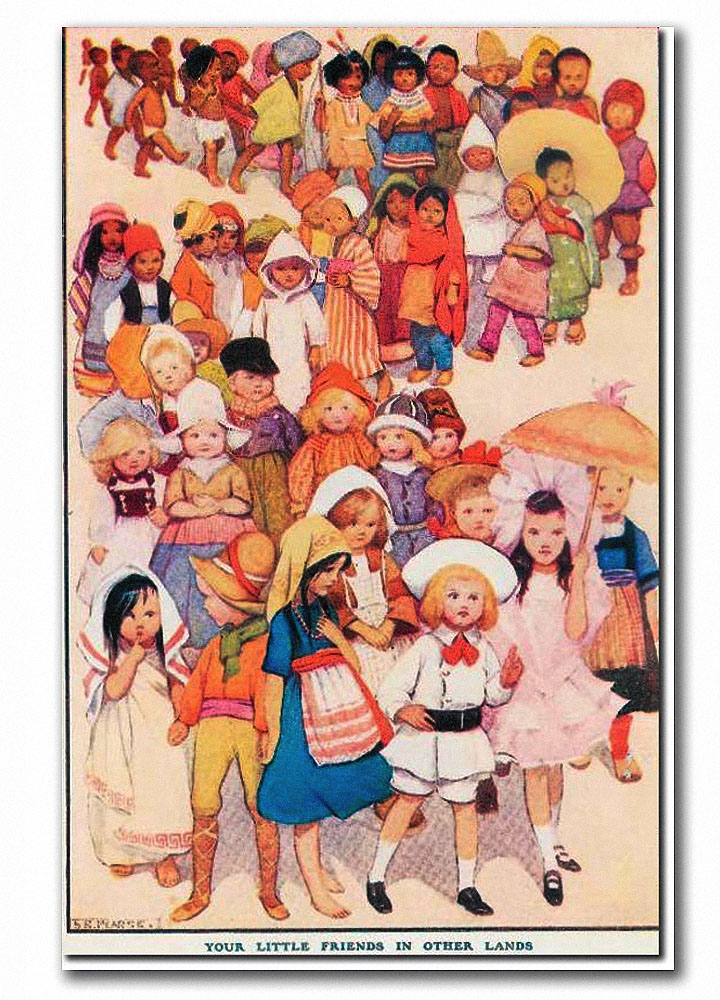
| Children of the world - the first thing that greets you in volume one. | |
 |
|
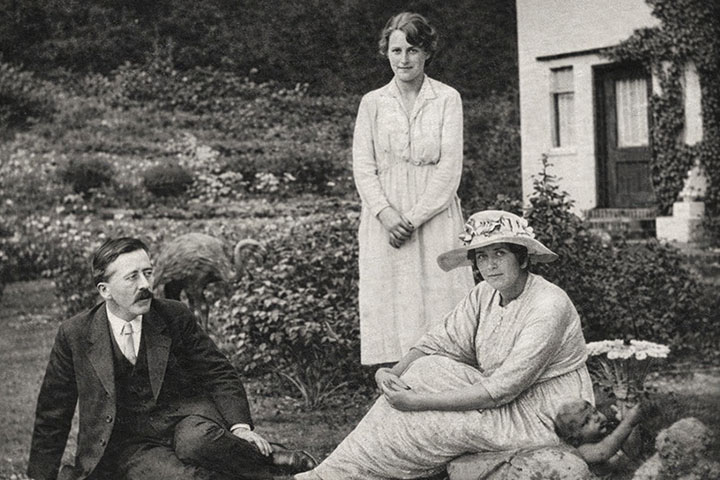
| The Mee Family - Arthur Henry Mee, Marjorie Ernestine Mee (daughter) and wife Amelia (Amy) Mee at Eynsford Hill. | |
 |
|
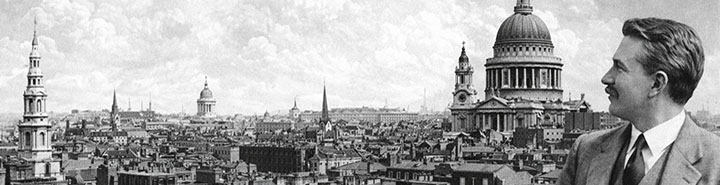
| Looking over London from the roof of the Children's Encyclopedia office. | |
 |
|
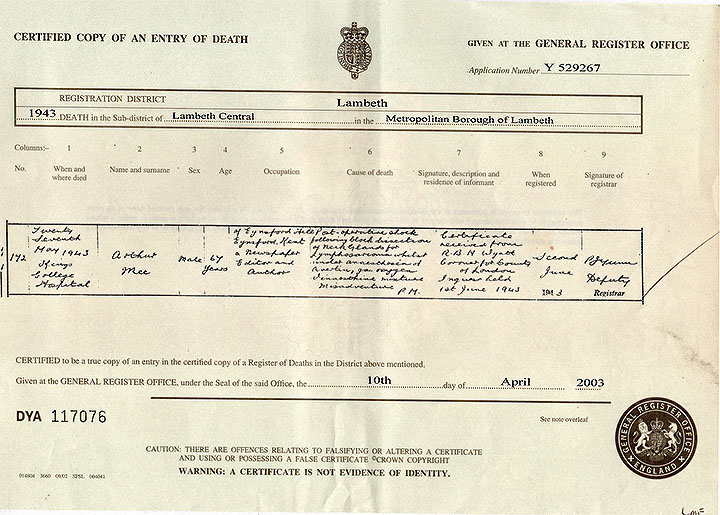
Death of Arthur Mee (1943) Arthur Mee died on 27 May 1943, aged 67, at King’s College Hospital, London. According to his death certificate, the cause of death was surgical shock following a block dissection of the neck glands, an extensive surgical procedure performed in the treatment of lymphosarcoma, an historical term for a form of lymphoma (cancer of the lymphatic system). The certificate states that death occurred whilst he was under anaesthesia, which included ether, gas, oxygen, and intravenous novocaine. This indicates that he died during the course of the operation rather than during post-operative recovery. The death was registered in the Lambeth Central sub-district of the Metropolitan Borough of Lambeth, and the certificate records that medical certification was provided by R. B. H. Yates, Coroner for the County of London, following an inquest. The death was registered in June 1943. The Times wrote: MEE.—On May 27, 1943, at King's College Hospital, Arthur Mee, beloved husband of Amy Mee, Eynsford Hill, Kent. Cremation private. His wish: Should any friends desire to buy a flower for me I beg that they will send a mite instead to some children's hospital with the simple words "For Arthur Mee."
|
|
 |
|
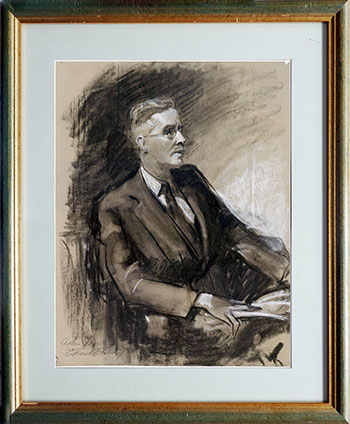
| Arthur Henry Mee by Frank Salisbury - charcoal; chalk, 1943 (National Portrait Gallery, London) | Mrs Amelia (Amy) Mee in 1916 |
The real 'Child of Wonder'. |
|
 |
|
|